
Looking for creativity
and witches

Creativity as divine, magical play
Julia Cameron starts The Artist’s Way with Spiritual Electricity.
“The heart of creativity is an experience of the mystical union; the heart of the mystical union is an experience of creativity. Those who speak in spiritual terms routinely refer to God as the creator but seldom see creator as the literal term for artist.”
It is a bold move. She risks putting off many, many readers. She acknowledges that some of us have a complicated relationship with the concept of a divine higher power, either because of the way it was imposed on us as children, or its narrow interpretations or the lack of scientific evidence, but urges us to step over the discomfort and get on with the work.
Her ten Basic Principles all exhort us to own our creativity, whatever name we choose to give it, because not only is it good to do so, it is imperative.
Rule #10 Our creative dreams and yearnings come from a divine source. As we move toward our dreams, we move toward our divinity.
Much has been written about the importance of play and flow in creative pursuits.
“The most creative people have retained a childlike ability to play,” John Cleese famously said.
Elizabeth Gilbert goes so far as to call it magic. She says creativity is inherently irrational. Ideas inhabit our world, just like plants and animals do, except they don’t have body, instead they have energy and will - the will to manifest themselves. Much like spirits from the spooky stories of my childhood.
“…ideas spend an eternity swirling around us, searching for available and willing human partners…When an idea thinks it has found somebody - say, you - who might be able to bring it into the world, the idea will pay you a visit. It will try to get your attention. Mostly, you will not notice…
But sometimes - rarely, but magnificently - there comes a day when you’re open and relaxed enough to actually receive something. Your defences might slacken and your anxieties might ease, and then magic can slip through. The idea, sensing your openness, will start to do its work on you…The idea will not leave you alone until it has your fuller attention.
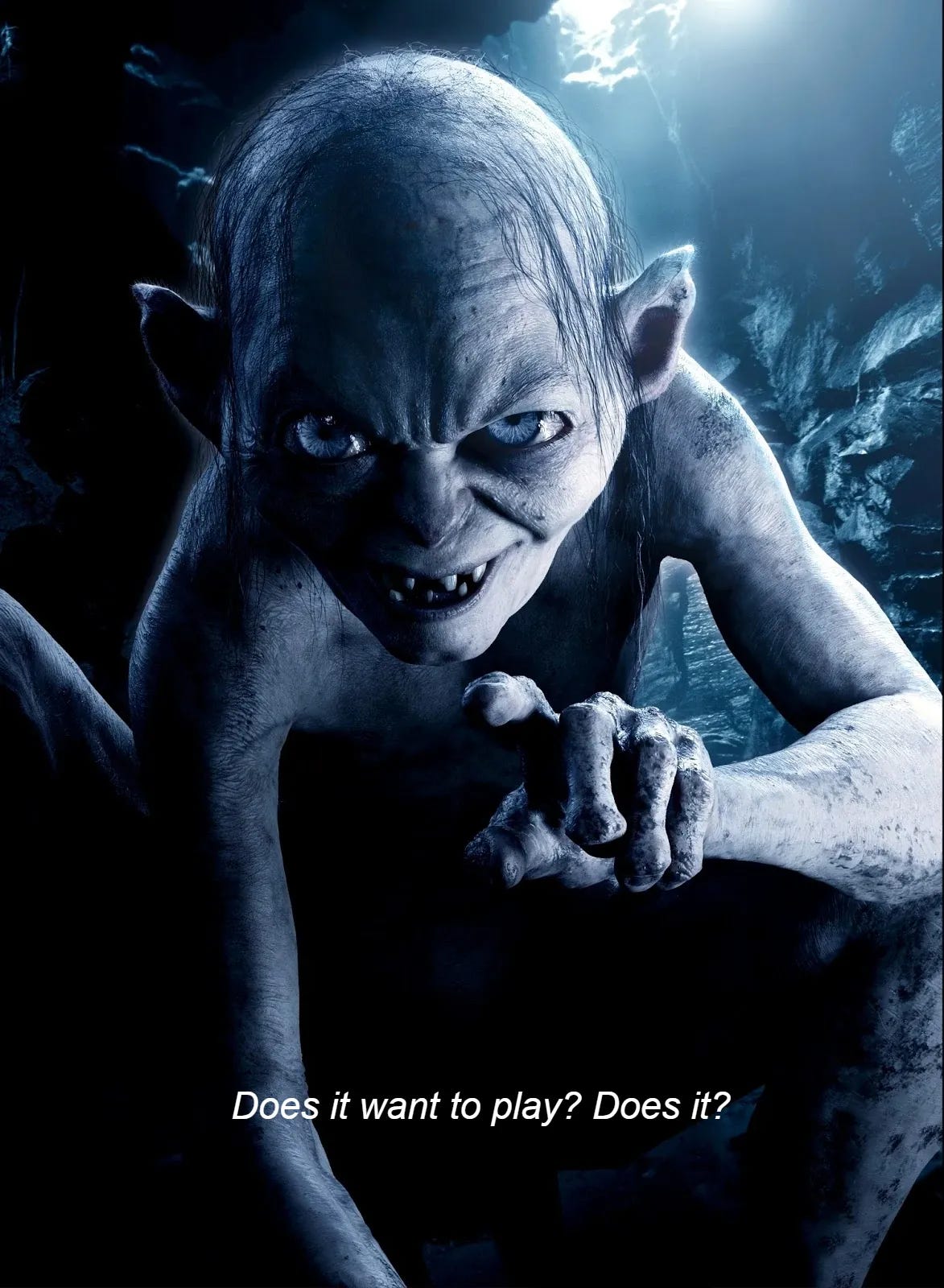
And then, in a quiet moment, it will ask, “Do you want to work with me?”
Divinity as pressure valves
My primary school peon, Peter, used to live on the grounds. His house was in a leafy corner of the big playground, near the water taps, nestled inside a grove of gulmohar and tamarind trees. In the sweltering summer days, the ground used to be ablaze with the fiery orange flowers and the trees bent with the sticky sour fruit, screaming to be picked and licked. Seniors said that grove was haunted, something about a witch in a white sari, long hair worn loose and toes pointing backwards, which only made us want to go there even more. But we didn’t dare because Peter lay on a charpai under the trees during recess. Impossible to tell if he was awake or asleep. He would shout at us through his missing front teeth for making noise and if we woke him up from his nap, he would wreak revenge by ringing in the end of recess two minutes earlier than the scheduled time. When we knew we had pissed him off, we would pre-empt his wrath and curtail the recess ourselves, and start walking to class even before he started hammering the gong.
If creativity is play, pressure is the dreaded school bell announcing the end of recess. Pressure to create, create something brilliant, create something so brilliant that it sells, create something so brilliant that it not just sells but brings fame (ps: international ideally).
Here again, we are pointed in the direction of the sky. Alain deBotton (one of the wisest people alive on the planet right now in my opinion), points out a fascinating, hugely under-acknowledged repercussion of not believing in a higher power:
“(In the modern world) We have secularised our yearnings for perfection. We now bring to bear on one another some of the expectations that people once used to bring to bear on gods. And that’s terribly unfair. Ordinary humans cannot have the perfection of gods…”
Its not just other people. We don’t spare ourselves either. we are fair like that. Someone recently pointed out another pitfall of not believing…when you don’t believe in a higher power with a higher wisdom, the whole thing, in its entirety, is all down to either random chance or worse…you. A misplaced, inflated sense of our own purpose on this planet which keeps us pounding the treadmill of productivity, fueled by existential anxiety to constantly earn our place, prove our worth. You might even go down the slippery slope of questioning your existence - Why am I here, what is the purpose, is there a point to all this? You might continue to look for meaning in other places - in your job, other people, in money, in science, any place but ‘that’. In the words of Anne Lamott (the wisest person on earth, and this is not my opinion, this is fact), “It’s like looking for bread in a hardware store. You are not going to find it.”
It is so much softer to think of divinity as a fluffy repository of all our ‘yearnings for perfection’. An expansive repository, big enough not to judge us for having these unreasonable yearnings, not to keep count of all the times we ourselves were less than perfect as ammunition to hurl back at us in the middle of an argument, instead owning them all; “Yes, yes, I am the all-seeing all-knowing one. Therefore you, little one, can put down your baggage of having to know everything, do everything everywhere all at once,” taking that unbearable load off of us and the people around us, to constantly perform, perfect, prove. A kindly school peon who not only sleeps through his bell ringing duties, but invites us, toothlessly, inside his house and up the trees to pick the most orange flower and the sourest fruit and go and say hello to the resident witch.
Resources:
Elizabeth Gilbert’s full article here: https://www.writersandartists.co.uk/advice/elizabeth-gilbert-writing-and-creativity
For more on Julia Cameron and The Artist’s Way: https://juliacameronlive.com/
John Cleese on Creativity and playfulness: https://www.youtube.com/watch?v=nvKeu46jgwo
This piece was written in the comfort of the calm and cosy CoCreateClub hosted by Raju Tai and Vimal Chitra.
Feeling much relief after reading this. I have been very good at taking Julia’s mentions of divinity with one pinch of salt per page. But this is a wholesome perspective I needed, esp right now. Thank you. A little bit of surrender goes a long way, in the creative life. :)
Nidhi, this essay is a GIFT!
Sending a sticky sweet warm hug in response.